
Why corrugated roofs are a problem
Corrugated roofs are the workhorse of British industry, found on warehouses, factories, agricultural barns and distribution sheds across the country. Their profiled sheets shed rainwater efficiently, but the thin metal or fibre-cement from which they are made offers almost no thermal resistance. As a result, heat pours out of the building in winter and builds up uncomfortably under the roof in summer, leaving the interior expensive to run and unpleasant to occupy throughout the year.
The deeper issue is condensation. When warm, moist internal air rises and meets the cold underside of a roof sheet, the air cools and can reach dew point, at which moisture condenses out and forms water on the metal. Over time this dripping soaks stored goods, corrodes steel sheets and fixings, and quietly degrades the structure, while the building remains both costly to heat and difficult to keep dry.
- Negligible thermal performance from thin profiled sheets
- Cold underside that reaches dew point and breeds condensation
- Corrosion of steel sheets, fixings and purlins over time
- Heat loss in winter and overheating in summer
- Dripping that damages stored stock and equipment
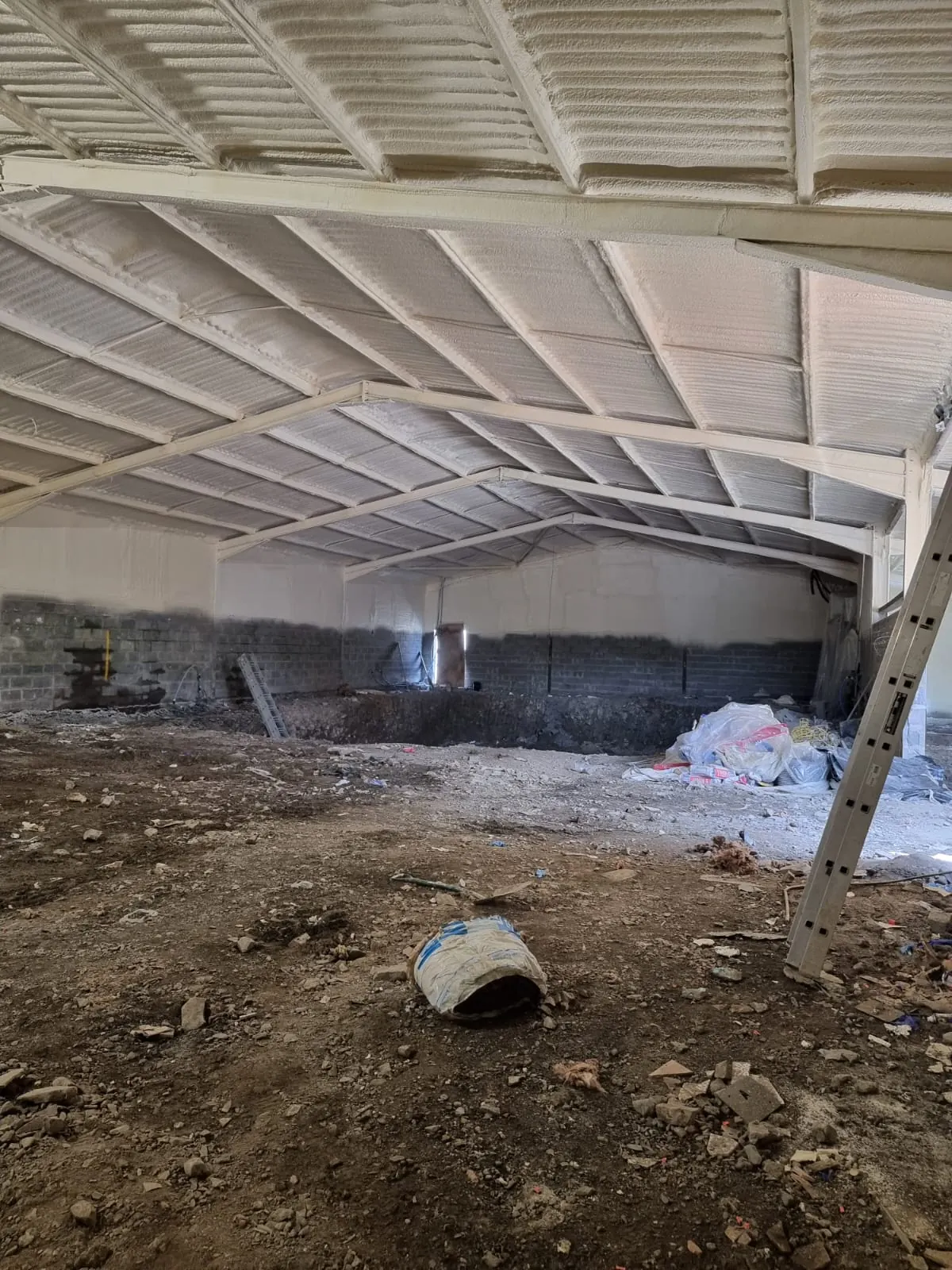
How closed-cell spray foam works
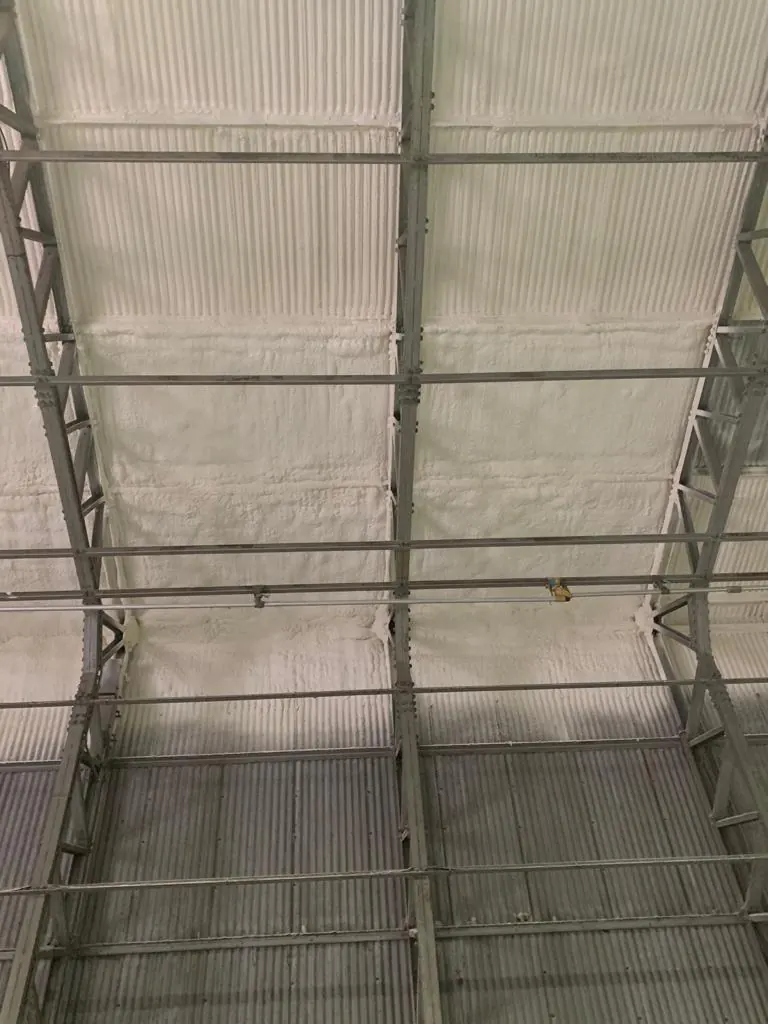
ThermoFoam uses Enverge closed-cell spray foam, applied under the Nexseal LE system, with Duratite as the UK distributor of record. The foam is spray-applied directly onto the clean underside of the existing roof, where it expands rapidly and self-bonds to the substrate as it cures. Because it is sprayed in place rather than fitted as a board, it follows every contour of the profiled sheet, sealing around laps and fixings without leaving the gaps that rigid panels inevitably create.
Once cured, the closed-cell structure forms a rigid, low-permeability layer that both insulates and resists the passage of moisture. By raising the temperature of the inner surface, it keeps that surface above dew point, so internal air no longer condenses against cold metal. The bonded layer also adds a measure of rigidity to the roof build-up and helps hold fixings and sheets in their original positions, reinforcing an ageing covering from beneath.
Key benefits for commercial buildings
For a working building, the headline gain is a warmer, drier interior achieved without disrupting day-to-day operations or stripping the existing roof. Application is carried out from inside, so the weather-tight outer covering stays in place and the business can keep running while the work is programmed around production, storage or stock movements. There is no need to expose the contents of the building to the elements during the project.
Beyond comfort, owners value the marked reduction in heat loss, the suppression of condensation and the seamless, protective skin the foam forms over a tired roof. Rather than facing the cost and upheaval of a full roof replacement, the existing structure is upgraded and its serviceable life extended. For many industrial and agricultural buildings, this is the most pragmatic route to a healthier internal environment and lower running costs.
- Warmer in winter, with more stable temperatures in summer
- Condensation controlled by lifting surfaces above dew point
- Seamless, gap-free coverage over complex profiles and laps
- Installed from inside with minimal disruption to operations
- Extends the working life of an existing roof
The survey and specification process
Every project begins with a site survey. The roof structure, sheet material, existing condition and the internal environment are all assessed so that the correct system and thickness can be specified for the building's particular use. Condensation risk is considered alongside how the space is heated, ventilated and occupied, because a cold store, a heated factory and an unheated barn each behave very differently and demand a specification tailored to their conditions.
Surface preparation is equally important. The substrate must be sound, clean and dry for the foam to bond correctly, so any contamination, damage or loose material is dealt with before application begins. Where a roof contains other materials or shows signs of failure, those issues are identified at survey stage. A clear written specification then sets out the chosen system, the preparation required and the conditions needed to achieve a durable, long-lasting result.
What makes a quality installation
A good outcome depends on trained applicators working to a clearly defined method. Foam is applied in controlled passes by operatives who understand how substrate temperature, ambient humidity and cure conditions affect adhesion and finish on a profiled roof. Rushing the work, or spraying in the wrong conditions, undermines the very performance the system is chosen to deliver, so disciplined application is not optional but central to the result.
ThermoFoam installs as a commercial specialist within the Duratite Group of Companies, working only on commercial, industrial and agricultural buildings and never on domestic property. Completed installations are backed by a 25-year manufacturer-backed product warranty on the Nexseal LE system, giving building owners genuine long-term assurance over the insulation they have invested in and confidence that the specification will perform as intended.